

Oudtshoorn is about to gain a new kind of neighbour: a working campus, built on sustainability principles, aimed squarely at the town's future workforce. On 1 September, Cango Wildlife will officially open its new Africa Skills Cango Academy site to an invite-only audience of civic and business leaders. Four days later, on 5 September, the doors open to the public for a community open day at 291 Adderley Street. Locals will be...
Poaching can happen on your doorstep too
Posted on Wed October 27, 2021.
Poaching is a harsh and ugly reality threatening a multitude of species globally. In many cases, it is single-handedly responsible for the endangerment and extinction of a species. Daily, we broach this subject on our educational guided tours to educate visitors on the plights of the species we house and the impact of bushmeat crisis. Never, not once, did we ever think that we would experience it on our own property.
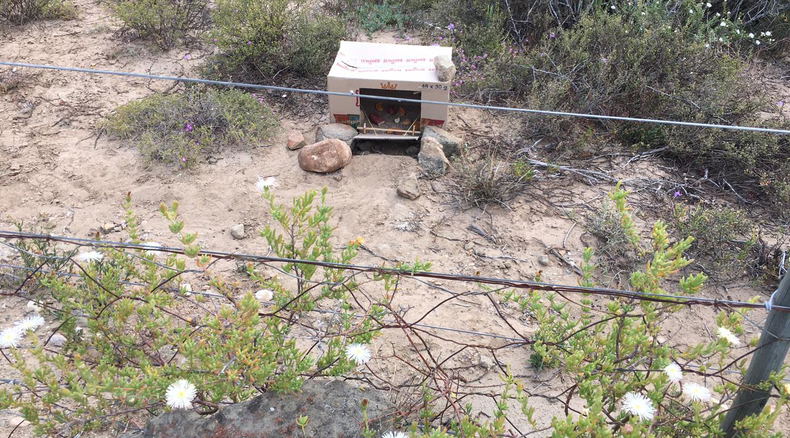
As per the images, these boxes, ie. tortoise traps, were discovered by our staff on our Private Reserve last week. Suspicions were roused after our staff saw a person fleeing the area, in the distance, during a routine trip to the reserve. Our staff were unable to find the culprit, but thankfully, they found the traps that had been placed. Immediately, local authorities were notified, and the boxes were removed.
The illegal capturing of wild animals is motivated by several reasons but there are two main factors, for food and for trade. Eating bushmeat can be attributed to cultural habits and preferences, and quite simply for survival. Trade though, is motivated by the demand of ‘valuable’ animal parts and products, by locals for socioeconomic benefits, and that of large international organized crime syndicates. This is fuelled by unproven religious, aphrodisiac, and medicinal uses, exotic food dishes, trophy hunts, and the illegal pet trade. But poaching does not only affect fauna, but flora too. Cape Nature is currently facing challenges in the Western Cape with succulent plant poaching. Believe it or not, the plant trade has changed into an operation much like that of rhino poaching, where the main role-players sit offshore, and the poaching is done by locals. Poachers are going into specific species localities and harvesting thousands of endemic plants that have limited distribution, thereby decimating natural populations. The fact that the plants are found nowhere else in the world makes them highly sought after and attractive to international collectors, leaving devastating effects on our biomes.
To say that we were furious and disheartened to find the traps is an understatement, but the silver lining is that now we can share this with thousands of wildlife advocates, to raise further awareness.
These simple but effective traps can be produced with very little and can be placed under bushes drawing minimal attention. It is also the perfect time of year, as all these little creatures become more active with the change of season. A video, demonstrating how the trap works, can be viewed in the comments section of this link: https://www.facebook.com/633406110021557/posts/4895353487160110/
Should you encounter anything of the sort whilst out and about, or should you ever witness suspicious activity pertaining to the natural environment, please report it to your nearest Cape Nature office or local authority.
Cape Nature Oudtshoorn: 044 203 6322
CONSERVE. CARE. CONNECT.
Share This Post
Latest News
-
 A New Campus And It Is Only The Beginning
Thu August 27, 2026 -
 Making Waves Beyond Cango
Thu August 27, 2026 -
 Two Peas In A Pod
Thu August 27, 2026 -
 A Cango Experience They’ll Carry Forever
Thu August 27, 2026 -
 The Story Behind The Menu
Thu August 27, 2026 -
 The Importance of Enrichment at Cango Wildlife
Thu August 27, 2026 -
 Knowledge, Laughter and a Little Friendly Competition
Fri July 31, 2026 -
 Shaping The Next Generation Of Wildlife Veterinarians
Thu July 30, 2026 -
 Walking Together
Thu July 30, 2026 -
 Celebrating The People Behind The Care
Thu July 30, 2026
Further Reading

A New Campus And It Is Only The Beginning
Thu August 27, 2026
Read This Article
Making Waves Beyond Cango
Thu August 27, 2026
Read This Article
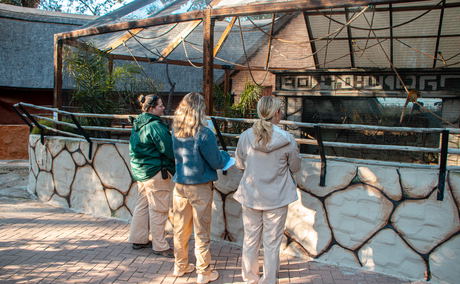
At Cango Wildlife, learning is not something that ends with a qualification. It continues every day through the animals in our care, the people we work alongside and the knowledge shared across the wider wildlife community. For Pippa, one of our dedicated Animal Caregivers, that passion for continued learning is now taking her beyond Cango Wildlife as she begins making her mark within the broader animal-care community. Recently, Pippa was invited to...
Two Peas In A Pod
Thu August 27, 2026
Read This Article
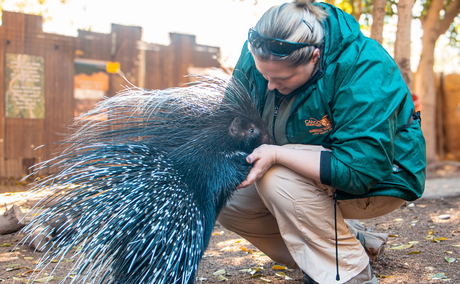
How patience, trust and training created a special bond between Animal Caregiver Pippa and Patricia, our Cape Porcupine When Patricia arrived at Cango Wildlife as a tiny baby, few could have predicted the relationship that would develop between this little bundle of quills and Animal Caregiver Pippa. For Pippa, however, the connection began with something very simple: time. Bottle feeds, playtime, cleaning and every spare opportunity to be around Patricia became the...
Share This Post