

There is a shift in the air this year. You will feel it as you move beneath the tree canopies, where 40 years of conservation have led to this moment. You will hear it first. The sound of excited children moving ahead. Searching. Running. Engaging with nature as it was always meant to be. On 4 and 5 April, we will host our third annual Easter Egg Hunt. This is not only...
Hunting Ghosts in Ancient Hills
Posted on Fri March 27, 2026.
A Fossil Excursion on our Private Reserve
I owe my fascination with dinosaurs to the 1993 science fiction adventure film, Jurassic Park, like many children of the 90’s. Ever since the silver screen palaeontologist, Dr Alan Grant, swept away loose soil with a paintbrush in the opening scene of the film, revealing something extraordinary hiding in plain sight, I have wanted to hunt for dinosaurs. So, when the invitation came to join a fossil hunt on my own home turf, I said yes before the sentence was finished.
On 20 April, I was invited to join a small team of explorers on an excursion into the Klein Karoo, including sections of our own private reserve, in search of trace fossils. Trace fossils are not the usual bones or teeth most people associate with fossils, but instead the preserved evidence of ancient movement: footprints, trackways, burrows. Finding them anywhere is remarkable. Finding them here, in the Oudtshoorn Basin, would be extraordinary.
The Ground Beneath Our Feet
To understand why, you need to know a little about the geology of the Klein Karoo.
 The Oudtshoorn Basin is one of the largest onshore Mesozoic basins in South Africa, formed when the supercontinent Gondwana began splitting apart roughly 180 million years ago. As the earth stretched and fractured, deep valleys formed and filled with layer upon layer of sediment. The result is the Uitenhage Group, a geological sequence that serves as a kind of diary of a world in violent transformation.
The most scientifically significant entry in that eonic diary is the Kirkwood Formation, the geological unit that underlies much of this region. Dating to the Late Jurassic and Early Cretaceous periods, it sits at a rare and fascinating boundary: a window into life as one geological era gave way to another, preserving evidence that many dinosaur groups survived far longer in southern Africa than was previously understood. The Kirkwood is famous for its "Wood Beds," containing vast numbers of fossilised logs and early evidence of wildfire in the form of ancient charcoal, and it preserves a landscape that was, at the time, a semi-arid mosaic of permanent wetlands and dense gymnosperm forests. It is, in short, a remarkable place to go looking.
The complication is that the Kirkwood Formation is also notoriously "messy" in geological terms. Its layers are heavily deformed and disrupted, making fossil identification difficult even for experts. The Klein Karoo also remains largely under-explored compared to its palaeontological potential, partly owing to that same complexity, and partly because this region simply hasn't received the research attention it deserves. That, however, is beginning to change.
The Team
 I was invited by explorer and caving specialist Sinead Hattingh of Heartbeat Adventures & Tours, who has an enviable talent for finding remarkable experiences hiding in this landscape. The science team she brought me into was formidable.
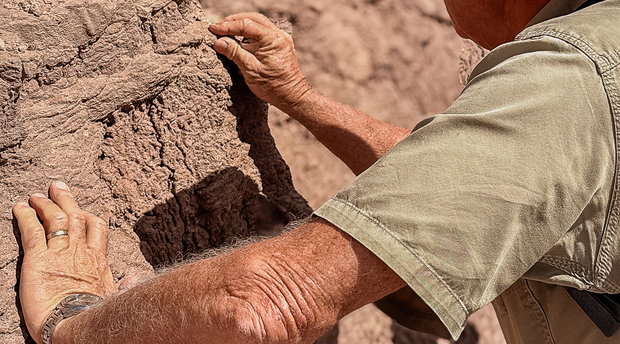
Dr Charles Helm is a South African physician turned ichnologist and Research Associate at Nelson Mandela University's African Centre for Coastal Palaeoscience. He is best known for documenting more than 250 vertebrate tracksites along roughly 350 km of South Africa's Cape south coast, including some of the oldest known Homo sapiens footprints on the planet. He arrived in full teaching mode, which suited me perfectly. Alongside him was his wife Linda Helm, whose sharp eye in the field has led to numerous significant discoveries, including the first identification of a dinosaur tracksite in the Brenton Formation. Veteran geologist Jean Malan, whose research helped formally describe the stratigraphy of the Cape south coast, and sedimentologist DeVille Wickens, an authority on the Karoo Basin whose doctoral research helped establish the Tanqua Fan Complex as a landmark for understanding deep-water sedimentary systems, rounded out the team. Not a bad group to spend a day with.
Into the Field
The team had already spent the previous day exploring near De Rust with limited results. The hope was that the Oudtshoorn area, with its clay and sandstone quarries and ancient hillsides shaped during the Jurassic and Cretaceous, might yield more.
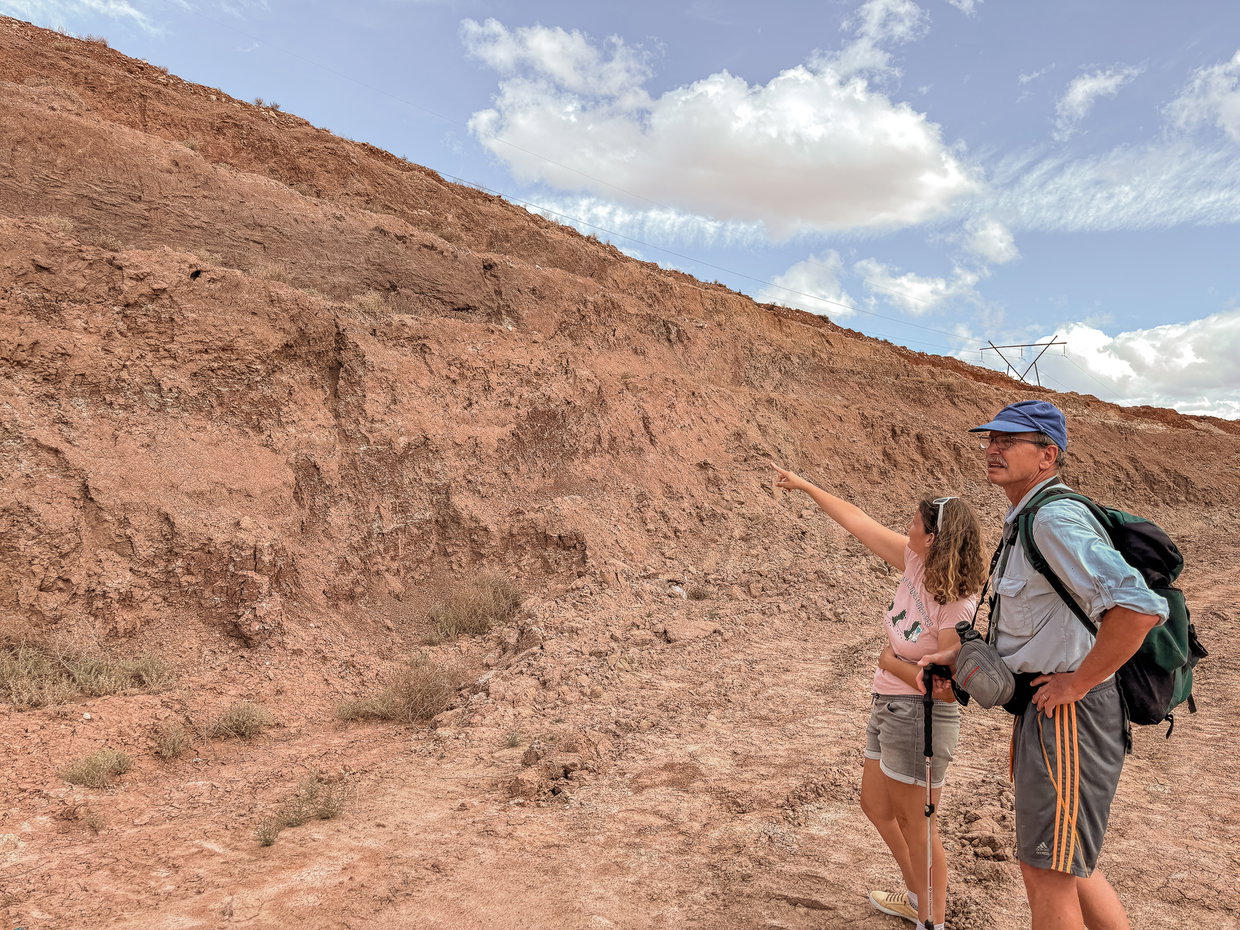
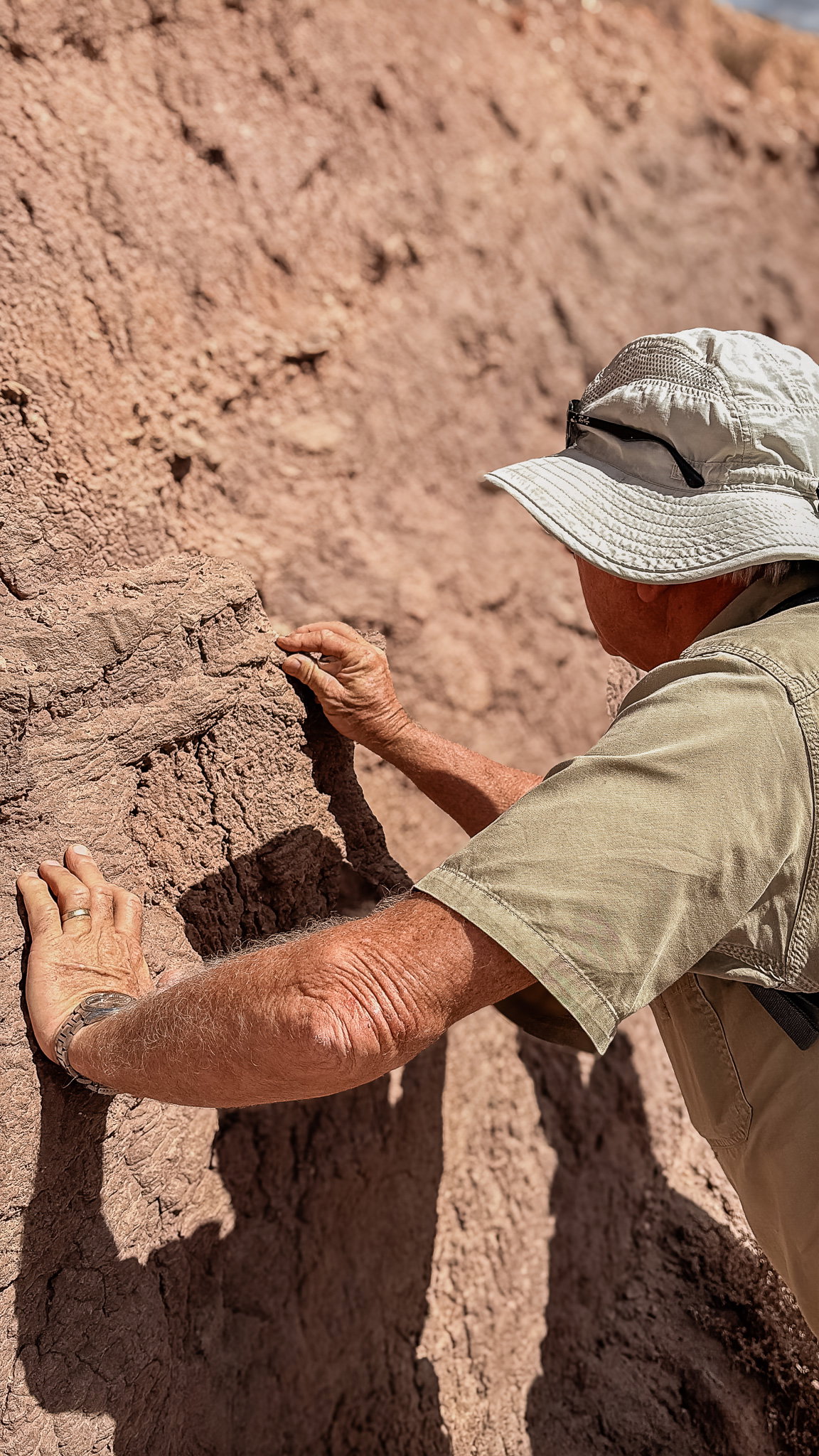
Our first stop was a brick works just outside Oudtshoorn, known for its exposed clay beds. After securing permission from the foreman, Charles led us along the embankments, explaining what to look for in trace fossil hunting: unusual dips in the otherwise consistent soil layers, shapes that cannot be explained by erosion or mechanical damage, interruptions in the sedimentary record that suggest something biological once pressed into this surface. Jean and DeVille, meanwhile, had already disappeared along the exposed geology like two schoolboys released at a beach, examining everything with unconcealed delight.
The challenge with clay environments, Charles explained, is that even when you find a probable anomaly, the soil composition makes it nearly impossible to expose it further without destroying it. Clay sites are better understood as reconnaissance territory, places to preview what might exist and to train the eye.
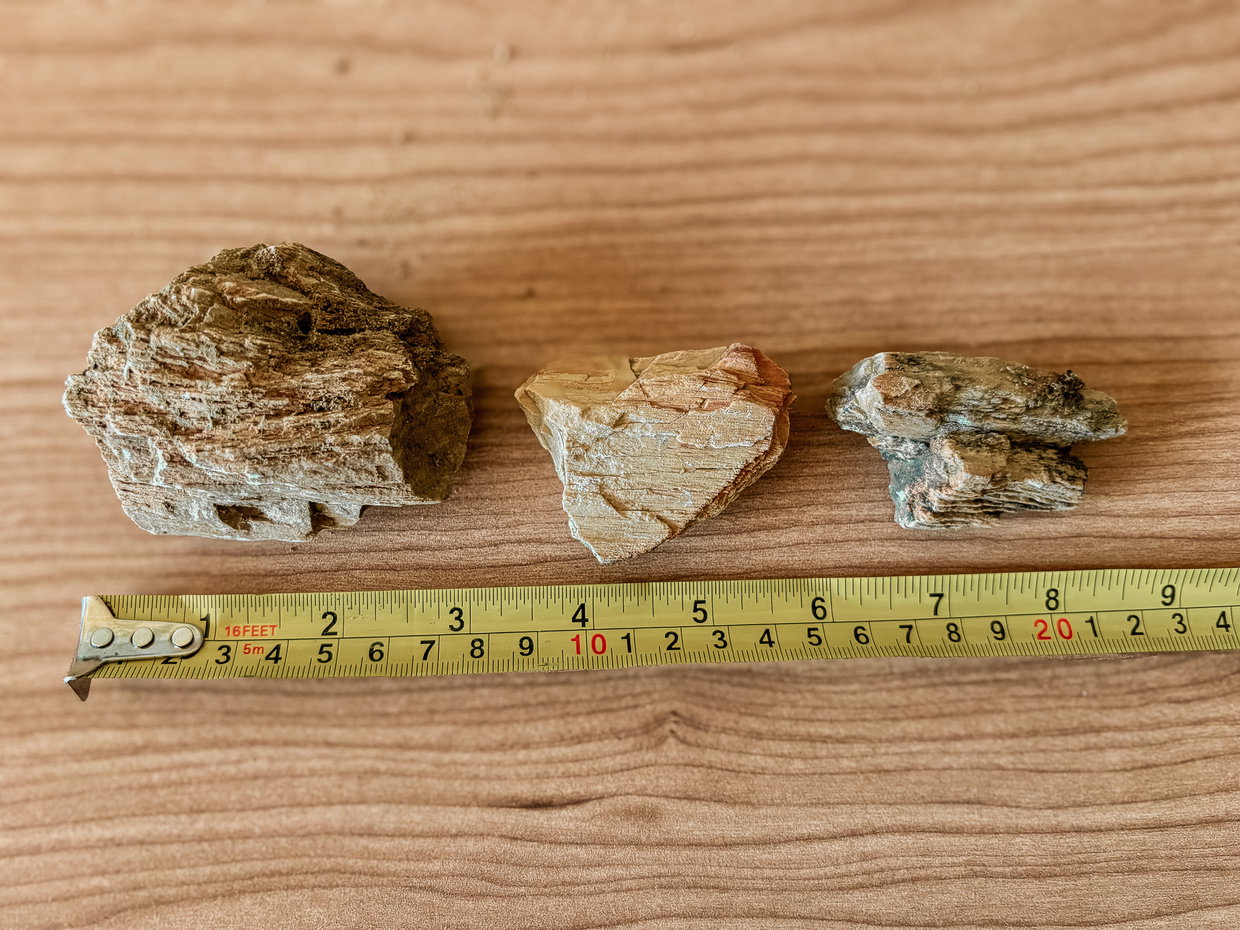 Our next destination was Cango Wildlife's own private reserve, which brought its own layer of history. In 1999, palaeontologists Dr Billy de Klerk and Dr Callum Ross had visited the site and recovered fossilised plants and wood, bone fragments, and, most exciting of all, two theropod teeth and a partial dinosaur pelvis. No palaeontologist had been back since. Until now.
Not to spoil the end of the story, but I should tell you immediately that we did and did not find something. We spent the better part of the afternoon navigating the reserve, searching for suitable outcrops. The Kirkwood Formation, true to form, was not giving anything up easily. I occupied myself doing what historians inevitably do: pointing out that the hills around us are dotted with sandstone quarries over 150 years old, once the primary source of building material for Oudtshoorn's older architecture. Charles was interested in this in exactly the way I expected, not for the history, but because old quarries mean exposed rock faces, and exposed rock faces mean potential. We made our way through deep dongas and over large boulders, past the cheetah breeding centre, and up to a substantial quarry at the crest of one of the larger hills.
Still nothing. But as we were preparing to leave, Charles and the team confirmed something important: this is precisely the kind of terrain where fossils should be found, consistent with where the 1999 team had made their discoveries. And, as if the reserve had decided to offer a small concession on our way out, we found a deposit of 135-million-year-old fossilised wood.
Not a dinosaur. Not a footprint. But 135 million years of time made solid, and that is not nothing.
What the Hills Are Keeping
The search has only just begun. Hopefully, Dr Helm and team will return, and I intend to keep looking in the meantime. I now know what I am searching for, and I know this ground better than most. If the hills here are holding something significant, I plan to be the one standing on it when it becomes visible. The Eriksenasaurus Rex will have to surface eventually.
Our reserve, I have come to understand more fully after this day, holds three distinct wonders: the ancient life encased in its impossibly old geology, the more recent human history written in its quarried sandstone hillsides, and the ongoing conservation work that makes it a living, breathing place today. It was always something special. It turns out it may be older and stranger than any of us realised.
I returned home exhausted, hungry, and very happy.
My thanks to Dr Helm and the entire team for allowing me to join them, and to Sinead for doing what she always does: finding something remarkable just around the corner.
Written by: Dr Garrett E Eriksen
Share This Post
Latest News
-
 Third Annual Easter Egg Hunt 4/5 April
Fri March 27, 2026 -
 Where Celebration Meets The Wild
Fri March 27, 2026 -
 A Quiet Strength, Now Carried Together
Fri March 27, 2026 -
 A Life In Care: From Curiosity To Calling
Fri March 27, 2026 -
 Where Care Meets Community
Fri March 27, 2026 -
 Hunting Ghosts in Ancient Hills
Fri March 27, 2026 -
 Strengthening Our Commitment To Animal Welfare: A Visit From Dave Morgan
Fri March 27, 2026 -
 From Placement to Purpose
Fri March 27, 2026 -
 From 1 Gram To The Night Sky
Thu February 26, 2026 -
 When Conservation Meets Celebration
Thu February 26, 2026
Further Reading
Third Annual Easter Egg Hunt 4/5 April
Fri March 27, 2026
Read This Article
Where Celebration Meets The Wild
Fri March 27, 2026
Read This Article
At Cango Wildlife, a children’s party becomes a full day of movement, discovery, and connection. Not a room. Not a routine. A space where energy runs free and curiosity leads the way. From the moment the group arrives, the experience opens up. A guided tour brings the wild closer. Wildlife Guardians share stories, small details, moments that shift how children see the animals around them. It sets the tone. This is not...
A Quiet Strength, Now Carried Together
Fri March 27, 2026
Read This Article
Some people never ask to be seen. They show up. They do the work. They hold things together, quietly and consistently. Aunty Jackie is one of those people. At our facility, every animal eats because of her. Every portion is measured. Every diet is prepared with care. It is precise work. Demanding work. Work that leaves no room for error. And for years, she has carried it with pride, discipline, and a...
Share This Post