


Oudtshoorn is about to gain a new kind of neighbour: a working campus, built on sustainability principles, aimed squarely at the town's future workforce. On 1 September, Cango Wildlife will officially open its new Africa Skills Cango Academy site to an invite-only audience of civic and business leaders. Four days later, on 5 September, the doors open to the public for a community open day at 291 Adderley Street. Locals will be...
Grace Beneath The Surface
Posted on Mon August 25, 2025.
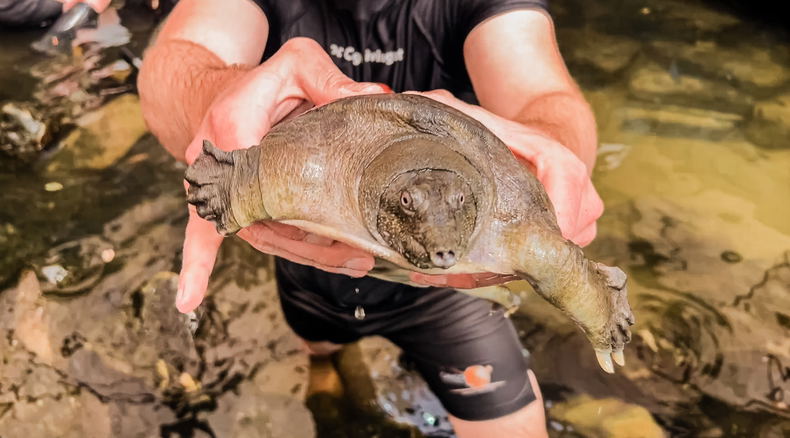
If you wander through the Valley of Ancients Temple and peer into our fish tank, you might be lucky enough to catch a glimpse of a truly remarkable creature - our female Chinese Softshell Turtle. Sharing her home with shimmering cichlids and lively Red-Eared Sliders, she is not always easy to spot. In fact, she is something of a hide-and-seek champion, slipping beneath the sand or nestling among the rocks where she almost disappears from view.
The Chinese Softshell Turtle is instantly recognisable thanks to her flat, leathery shell. Unlike most turtles with hard, domed carapaces, hers feels soft to the touch and bends slightly at the edges. This unique design makes her a far stronger swimmer than most of her relatives, allowing her to glide through the water with elegance and speed. She may look unusual, but when danger approaches, she is still able to tuck her head in for protection, just like other turtles, a clever reminder of her evolutionary resilience.
Her long, snorkel-like nose is one of her greatest assets. It allows her to breathe while keeping most of her body hidden under sand or water. She can also absorb oxygen directly through her skin and throat lining, which helps her stay underwater longer than most turtles. These adaptations make her both a stealthy hunter and a master at conserving energy.
Native to rivers, lakes, and ponds across China and Southeast Asia, Chinese Softshell Turtles spend much of their lives half-buried in mud or sand. They are opportunistic eaters, feeding on fish, insects, crustaceans, and even plants. Despite their tough survival skills, wild populations face serious threats from habitat loss and overharvesting, making every individual an ambassador for their species’ conservation.
So, next time you’re in the Valley of Ancients Temple, look closely into the tank. Among the darting cichlids and basking sliders, you may notice the shadowy glide of our softshell turtle. Patient, graceful, and full of surprises, she reminds us that nature’s beauty is often hidden in plain sight.
Share This Post
Latest News
-
 A New Campus And It Is Only The Beginning
Thu August 27, 2026 -
 Making Waves Beyond Cango
Thu August 27, 2026 -
 Two Peas In A Pod
Thu August 27, 2026 -
 A Cango Experience They’ll Carry Forever
Thu August 27, 2026 -
 The Story Behind The Menu
Thu August 27, 2026 -
 The Importance of Enrichment at Cango Wildlife
Thu August 27, 2026 -
 Knowledge, Laughter and a Little Friendly Competition
Fri July 31, 2026 -
 Shaping The Next Generation Of Wildlife Veterinarians
Thu July 30, 2026 -
 Walking Together
Thu July 30, 2026 -
 Celebrating The People Behind The Care
Thu July 30, 2026
Further Reading

A New Campus And It Is Only The Beginning
Thu August 27, 2026
Read This Article
Making Waves Beyond Cango
Thu August 27, 2026
Read This Article
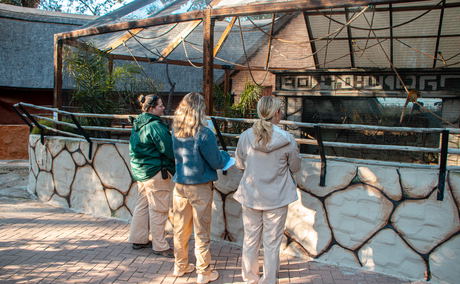
At Cango Wildlife, learning is not something that ends with a qualification. It continues every day through the animals in our care, the people we work alongside and the knowledge shared across the wider wildlife community. For Pippa, one of our dedicated Animal Caregivers, that passion for continued learning is now taking her beyond Cango Wildlife as she begins making her mark within the broader animal-care community. Recently, Pippa was invited to...
Two Peas In A Pod
Thu August 27, 2026
Read This Article
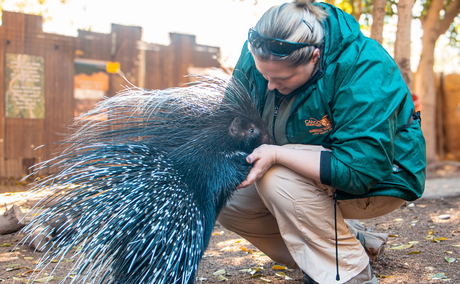
How patience, trust and training created a special bond between Animal Caregiver Pippa and Patricia, our Cape Porcupine When Patricia arrived at Cango Wildlife as a tiny baby, few could have predicted the relationship that would develop between this little bundle of quills and Animal Caregiver Pippa. For Pippa, however, the connection began with something very simple: time. Bottle feeds, playtime, cleaning and every spare opportunity to be around Patricia became the...
Share This Post