

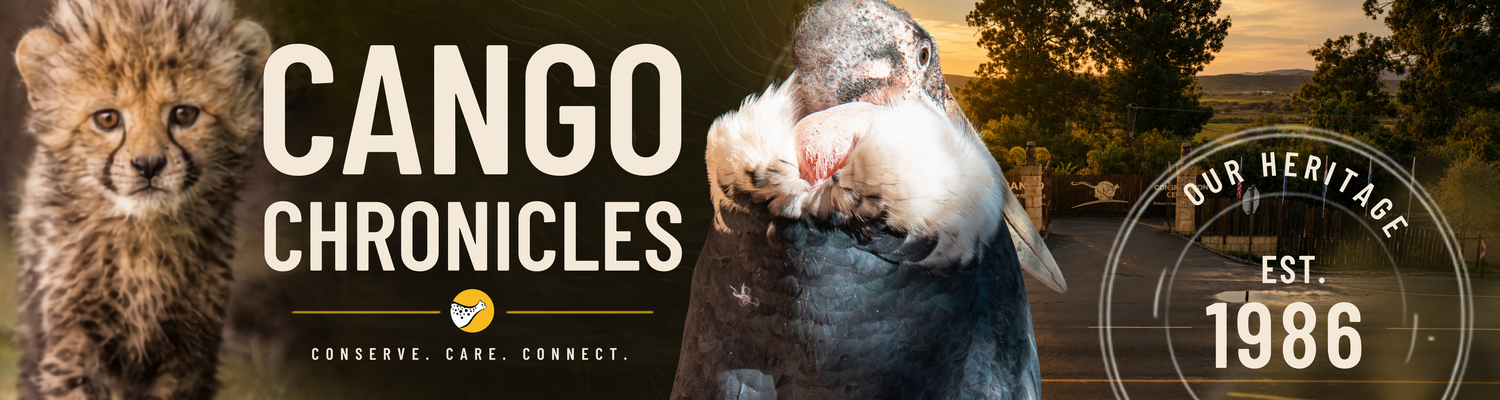
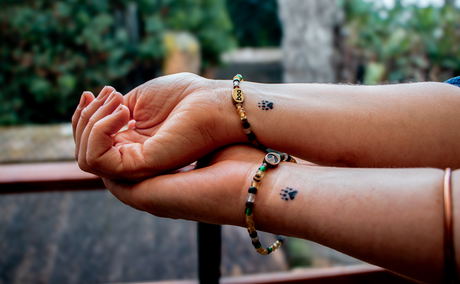
Some memories are captured in photographs. Others come home with you in a slightly more permanent way. For Australian volunteers Jamie, Hayley and Jess, and Cango Academy student Zenny, their time together in the Klein Karoo was marked with an experience they will quite literally carry with them forever.
Two Peas In A Pod
Posted on Thu August 27, 2026.
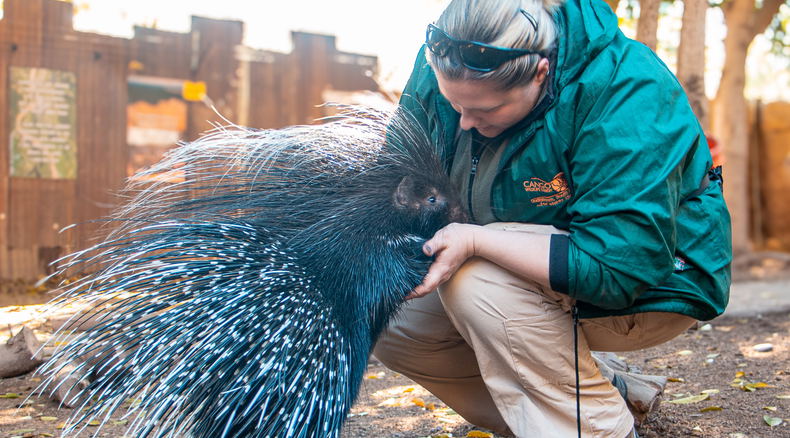
How patience, trust and training created a special bond between Animal Caregiver Pippa and Patricia, our Cape Porcupine
When Patricia arrived at Cango Wildlife as a tiny baby, few could have predicted the relationship that would develop between this little bundle of quills and Animal Caregiver Pippa.
For Pippa, however, the connection began with something very simple: time.
Bottle feeds, playtime, cleaning and every spare opportunity to be around Patricia became the building blocks of a relationship that has grown into something incredibly special.
“What surprised me was just how quickly we formed such a strong bond. I’d never think I’d have such a strong bond with an animal, let alone little Patricia.”
Getting to Know the Animal Behind the Quills
Porcupines don't exactly have a reputation for being cuddly. Their impressive coat of quills is, after all, designed to make potential threats think twice.
But spend enough time with Patricia and another side quickly emerges.
Pippa describes porcupines as incredibly intelligent and curious animals, each with their own distinct personality. While their quills should certainly be respected, there is much more to them than their natural defence mechanisms.
Once trust is established, they can even show affection in their own unique ways.
And Patricia certainly has personality to spare.
One of her favourite activities has become affectionately known as her “zoomies.”
“Patricia gets zoomies, and it’s the absolute best thing ever! I have spent hours over the last couple of months running around and zooming with her. She’s so playful and has such a big personality.”
For Pippa, being able to witness these behaviours up close, and to have Patricia actively choose to interact and play with her, is a privilege she doesn't take for granted.
From Bottle Feeds to Best Friends
During their first week together, Pippa says the pair were still very much figuring each other out.
Although, admittedly, Patricia didn't have to work particularly hard to win her over.
“I was in complete awe of her from the first time I met her,” Pippa says. “I was infatuated since I gave her the first bottle.”
Months later, that early fascination has developed into a relationship built on familiarity, consistency and trust.
“Now we have a very strong bond and somehow understand each other having never said a single word to the other. We are two little peas in a pod.”
But behind the adorable moments and Patricia's famous zoomies is something incredibly important: animal husbandry training.
Training With a Purpose
Training at Cango Wildlife isn't about teaching animals tricks for entertainment. It is an important part of modern animal care and can play a significant role in an animal's health, welfare and day-to-day management.
Pippa works with Patricia using positive reinforcement, where Patricia receives something she values after voluntarily completing a desired behaviour. This encourages her to participate and helps make training a positive experience.
Sessions are carefully structured according to what Pippa hopes to achieve that day.
She generally begins with a simple, familiar behaviour before moving into the main focus of the session, which may include husbandry or medical training. The session then ends with another familiar behaviour and a larger, or “jackpot”, reward.
Ending positively helps Patricia remain engaged and eager to participate in future sessions.
The greatest challenge isn't necessarily teaching a particular behaviour.
Instead, Pippa says it is about remaining consistent and ensuring Patricia genuinely understands what is being asked of her.
Animals, just like people, don't necessarily respond exactly the same way every day. Caregivers therefore need to adapt while still communicating consistently.
A Walk Worth Celebrating
One of Pippa's proudest breakthroughs has been Patricia's walks.
Through gradual training, Patricia became comfortable with her harness and the process of going for walks. Today, she can comfortably explore different areas around the facility with her caregivers.
For Pippa, it represents far more than simply teaching Patricia to walk on a harness.
“It really shows just how much she trusts us and how comfortable she is in her training. She actually looks forward to the walks on a day-to-day basis.”
That willingness to participate is at the heart of positive reinforcement training.
Rather than forcing cooperation, caregivers work towards giving animals the opportunity to voluntarily participate in aspects of their own care.
When Training Becomes Healthcare
Imagine needing to examine an animal but being able to ask them to voluntarily present a particular part of their body rather than having to physically restrain them.
That is where husbandry training can become incredibly valuable.
Behaviours can be developed to assist with routine examinations, veterinary procedures and general animal management. By teaching animals to voluntarily participate where appropriate, certain procedures can become safer and less stressful for both the animal and the people caring for them.
As Pippa explains:
“Training isn’t just about teaching an animal tricks. It’s about improving communication, welfare and husbandry.”
Ultimately, the goal is better animal welfare, and every small training session contributes towards that bigger picture.
The Lesson Patricia Taught Pippa
While Pippa has spent months teaching Patricia, she says Patricia has taught her something equally valuable.
Patience.
Trust doesn't happen overnight, particularly between a caregiver and a wild animal. It is built through consistency, respect and countless seemingly insignificant interactions.
Then, eventually, those little moments begin adding up.
An animal recognises you. They approach you willingly. They become excited for a training session. Or perhaps they simply choose to spend time with you.
“It’s taught me that the small moments of progress are often the ones that mean the most.”
For Pippa, those moments with Patricia have created a relationship she never expected to experience.
And she hopes Patricia might change the way others see porcupines too.
Beyond the quills are intelligent, curious animals with individual personalities, preferences and behaviours. In the wild, porcupines also form part of functioning ecosystems and, like so many less celebrated species, deserve our interest and respect.
Patricia may have arrived at Cango Wildlife as one very small porcupine, but for Pippa, she has become an unforgettable reminder of what can happen when patience, knowledge and trust come together.
Sometimes, the strongest relationships really do start with a bottle, a few zoomies and a whole lot of patience.
Share This Post
Latest News
-
 A Little Piece Of Africa, Forever
Wed September 30, 2026 -
 From Cango To Kruger: Sharing The Story Of Project ZOA
Wed September 30, 2026 -
 Planting For The Future: Arbor Month Takes Root At Cango Academy
Wed September 30, 2026 -
 Building Trust, One Click At A Time
Tue September 29, 2026 -
 Trust Is Earned, Not Expected
Tue September 29, 2026 -
 Born To Be Wild: Celebrating 40 Years & Building The Next 40
Tue September 29, 2026 -
 Coming Home To Cango
Tue September 29, 2026 -
 A New Campus And It Is Only The Beginning
Thu August 27, 2026 -
 Making Waves Beyond Cango
Thu August 27, 2026 -
 Two Peas In A Pod
Thu August 27, 2026
Further Reading
A Little Piece Of Africa, Forever
Wed September 30, 2026
Read This Article
From Cango To Kruger: Sharing The Story Of Project ZOA
Wed September 30, 2026
Read This Article
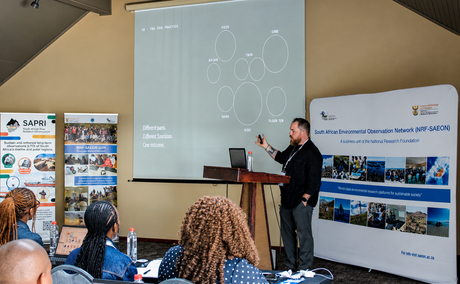
Cango Wildlife CEO Douglas Eriksen recently took Project ZOA to a new audience, delivering the keynote address at the 18th NRF-SAEON Graduate Student Network Indibano in Hazyview, Mpumalanga, on 16 September 2026. The South African Environmental Observation Network (SAEON), a research platform of the National Research Foundation, brings together scientists working across South Africa’s terrestrial, marine, freshwater and atmospheric environments. Its Graduate Student Network connects Master’s and PhD researchers from across the...
Planting For The Future: Arbor Month Takes Root At Cango Academy
Wed September 30, 2026
Read This Article
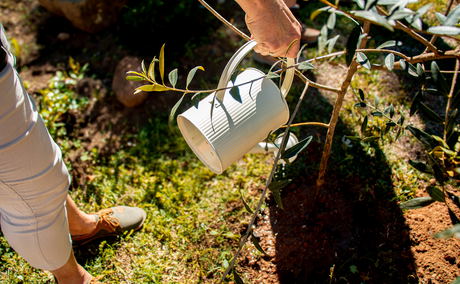
The final day of Arbor Month brought with it a fitting moment of growth at the newly opened Africa Skills Cango Academy, as representatives from the Garden Route District Municipality joined the Cango team for the handover and planting of indigenous trees. The Garden Route District Municipality donated 35 indigenous plants, comprising 20 Karee trees and 15 Spekboom, to be planted at the Academy. The initiative formed part of Arbor Month and...
Share This Post